When my pal and fellow monster enthusiast
Ben Jeddrie admitted to me a few weeks ago that he’d never seen
The Creature From The Black Lagoon, I was stunned, but also thrilled, because that gave me an excuse to watch Jack Arnold’s 1954 classic again. The 1980 Roger Corman-produced offshoot
Humanoids From The Deep came up in conversation around the same time, and the idea for a double feature was born.
I was tempted to hold off on revisiting
Black Lagoon until
this fall’s forthcoming Blu-Ray release (as part of Universal’s
Classic Monsters 8-movie set), but we’re talking about the Gillman here! Who can wait? By today’s standards, this film’s pacing is pretty stodgy, but as far as old school monster SF goes, you can’t really do much better. It has all the hallmarks of the period—lots of casual smoking, healthy yet occasionally fisticuffed debate amongst two leads (one who wants to study the newfound Creature and one who just can’t wait to jam a harpoon up its ass), lots of local flavour from the ill-fated South American guides and the jolly captain of the
Rita, a gorgeous Julia Adams on board for eye candy, and, of course, one of the still-coolest monster designs ever put to film.

The Gillman was designed by an uncredited Millicent Patrick and constructed by Bud Westmore, and man, is he ever cool. He’s definitely one of the more sympathetic monsters in the classic Universal lineup—he’s just doing his lonely, evolutionarily-impossible thing in the jungle, and these science jerks show up and start trying to poison and harpoon him all over the place. The three-note theme music that accompanies his appearances is pretty nifty—a brassy “Bwa-bwa-BWAAAAAA!” that is the audio equivalent of someone walking up behind you, grabbing you by the shoulders, and shaking you back and forth violently. The underwater sequences are striking and beautiful, especially the scene where Julia Adams goes for an afternoon dip, not realizing that the Gillman is watching, fascinated, from the murky depths, mirroring her swimming moves. Despite his tragic end here, the Creature showed up for two increasingly-ridiculous sequels—1955’s
Revenge Of The Creature (notably mostly for featuring one of
Clint Eastwood’s earliest screen appearances as a lab assistant), and 1956’s
The Creature Walks Among Us, which sees the poor guy trade in his gills for a sensible pantsuit.
A couple of side notes—if you dig the Gillman as much as I do, you owe it to yourself to visit comic writer
Steve Niles’ Tumblr, which is jam-packed with cool old monster images, and is possibly the greatest resource for
Black Lagoon ephemera on the web. Also, feast your eyes on Francesco Francavilla’s stunning
Creature poster, previously available as one of those beautiful but super-limited edition prints from
Mondo.
Keeping in mind the Gillman’s amorous advances towards Ms. Adams, 1980’s
Humanoids From The Deep takes the idea to its more logical, but icky, conclusion. The mutant fishmen of Barbara Peeters’ exploitation classic (available in an extras-packed DVD or Blu-Ray from the good folks at
Shout! Factory) have only one thing on their mind—sexy dames and plenty of ‘em. Oh, sure, they’re just as happy to rip the faces off the unsuspecting men of the small fishing village of Noyo, but what they really want is to procreate.
This is a movie that lets you know right off the bat what you’re in for. A small child is the first victim (thankfully, he only gets eaten, we assume), but with that as its opener,
Humanoids establishes that nobody’s getting off easy here. A small army of aquatic beasties rises up from the waters around Noyo, the supposed result of kooky science experiments conducted at the local cannery or something. Director Barbara Peeters wasn’t interested in depicting merman rape in her film, so the always-devious Roger Corman had another director shoot additional footage of the attacks--pretty unpleasant stuff. On the other hand, there is some very weirdly funny stuff going on here too; there's a scene involving a horny would-be ventriloquist and his dummy that provides the movie's biggest, strangest laugh. The story culminates in a nighttime assault on the crowded boardwalk during a festival, where the townspeople go to war against the Humanoids in a chaotic finale filled with good, gory fun.

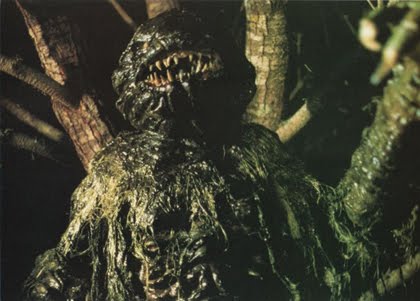
The cast, led by a large-faced Doug McClure, is pretty uninvolving, but Vic Morrow’s permed, mustachioed performance as a racist jerk livens the proceedings up a bit. The real reasons to watch are the Humanoids, created by an extremely young Rob Bottin (who would have been around 19 at the time). The impossibly-long limbed, slimy, shaggy, toothsome creatures look like the love child of the Gillman and the Metaluna Mutant from
This Island Earth, with a bit of Audrey Two from
Little Shop Of Horrors thrown in for good measure. James Horner contributes a cool, creepy score, and the hand-puppety finale is worth sticking around for. Definitely not for everyone, but a must for fans of vintage 80s monster cheese.