Tuesday, October 30, 2012
31 Days Of Horror 2012 (Part 12)
WHO CAN KILL A CHILD? (1976):
The opening credits of Who Can Kill A Child? play over a montage of documentary footage that chronicles how some of the most unimaginable tragedies of the last century--the Holocaust, the Korean conflict, the Vietnam war--have been hardest on the children of the countries involved. This lengthy sequence (one that surely rivals Once Upon A Time In The West for the title of Longest Opening Credits Sequence In Cinema History), which combines footage of real-life corpses and atrocities with the sound of kids laughing and singing, is meant to set up the film's central idea--the murderous children in the movie are theorized by the hero to have taken some sort of evolutionary leap, and are ensuring their own future survival by killing every adult they see. It's a bit of a jump to make to come to this conclusion; one imagines that the protagonist must have watched the same opening credits sequence as the audience in order to reach that hypothesis. There may have been more to it than that--the version of the film I watched had no English dialogue other than the opening voiceover and the dialogue spoken by the two leads, who are thankfully British (and one of them doesn't speak Spanish, so her husband needs to translate for her). But I digress. Who Can Kill A Child? opens as a married couple, pregnant Evelyn and moustachioed Tom, vacationing on the Spanish coast, decide to visit a tiny island with a population of just a few hundred people. They arrive to find the place mostly deserted, except for the occasional smiling child or two. Those children are smiling because a kind of contagious madness has come to the island--one that only affects the preteen set. The grownups are all missing because the happy-go-lucky tykes have happily slaughtered them all, and Tom and Evelyn are next. The movie's title comes from the central dilemma posed to Tom and Evelyn--can you justify killing a child, much less a small army of them, if they're hellbent on killing you first? Tom is pushed to that limit out of self-preservation, but Evelyn is hesitant because of the child in her belly (an enemy in their midst, as it turns out). At nearly two hours, Who Can Kill A Child? is a bit of a slow burn, but it really ramps up in the last half hour. The minimal use of music adds a spooky atmosphere, and the smiling, giggling children are definitely unsettling--they're a bit like the avian killers in The Birds in that you'll see one or two, then dozens surrounding the hapless adults. The final waterfront showdown is brutal, and the ending is a classic downer in the mold of the original Night Of The Living Dead. Highly recommended, but not if the content implied by the movie's title makes you at all uneasy.
Monday, October 29, 2012
31 Days Of Horror 2012 (Part 11)
I WALKED WITH A ZOMBIE (1943):
The word "atmospheric" gets thrown around in discussions of director Jacques Tourneur's work almost as much as the word "adorkable" is used to describe Zooey Deschanel. But it's certainly apt. Maybe even more so than the director's Cat People and Curse Of The Demon, I Walked With A Zombie goes for an overall mood of gorgeously-shot eeriness rather than big, spectacular scares. A Canadian nurse (Frances Dee) is hired to look after the brain-damaged wife of a plantation manager (Tom Conway) in the West Indies, and her curiosity about the woman's mysterious ailment leads her to investigate alternative treatments--like the ones practiced in voodoo rituals by the local plantation workers. We learn of a love triangle between Paul, his wife Jessica, and Paul's brother Wesley, which may have led to her condition. The possibility arises that Jessica has fallen under a voodoo curse, and that she may not even be technically alive at all anymore. But who cursed her, and why? The film keeps you guessing as to whether or not supernatural forces really are at work, or if it's all the result of jealousy, forbidden love, and mental illness. Viewers drawn to the title looking for a Romeroesque apocalypse of walking corpses will be pretty disappointed--I Walked With A Zombie is much more of a romantic melodrama with supernatural undertones than anything else. But it remains a sterling example of classy studio horror of the era. And even nearly 70 years later, the image of the giant, pop-eyed voodoo enforcer Carrefour is still pretty startling.
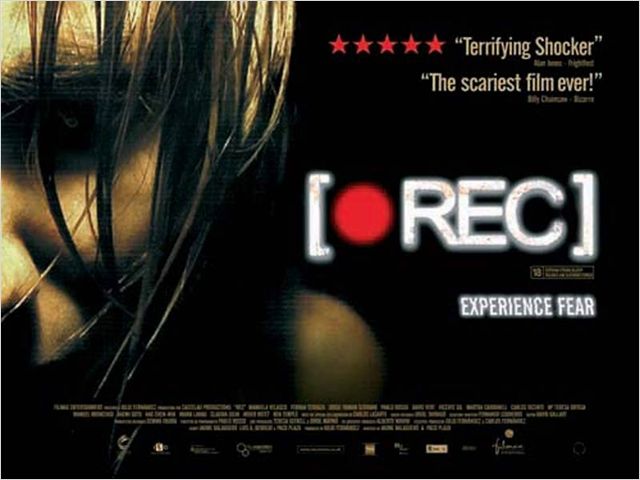
REC (2007) and REC 2 (2009):
If you wanna make me roll my eyes at you, recommend I watch a) another goddamned zombie movie, b) another goddamned found-footage movie, or c) a goddamned found-footage zombie movie. But the first two installments in the Spanish-language REC movie series make these tired horror cliches fresh, exciting, and terrifying all over again. The key to the series' success so far (a third film has been released in Spain, but I have no idea when it'll arrive in North America) has been its inventive use of the you-are-there immediacy of the found footage format (courtesy of co-directors Jaume Balaguero and Paco Plaza), and a fascinating mythology that blurs the line between the supernatural and the scientific. In the 2007 kickoff to the franchise, we follow a TV crew recording a show called While You're Asleep as they follow a group of firemen on their nightly duties. When the firemen are summoned to a nearby apartment building on a mysterious emergency call, they find themselves--along with the terrified cameraman and TV host (Manuela Velasco)--trapped inside the now-quarantined building with its hapless residents as a strange virus, transmitted through blood and saliva, turns its victims into the spazziest ghouls this side of Return Of The Living Dead. As the story progresses, we learn that the building's penthouse has been home to a mysterious old priest who has been performing strange experiments on a young girl. The hair-raising final moments of REC take us inside the penthouse as the remainder of the building is overtaken by the lunatic zombies, who are not undead at all but are instead victims of a particularly contagious strain of demonic possession. The priest who lived there had been trying to find a scientific cure for the strain, but to no avail...and his unbelievably gross Patient Zero is still lurking about! 2009's REC 2 picks up mere moments later, as a SWAT team enters the still-quarantined building with a health official (Jonathan D. Mellor) who is not what he seems. The sequel keeps things fresh with a whole new bag of cinematic tricks--things veer into Aliens territory, not to mention first-person-shooter video game territory, when the SWAT guys activate their helmet-cams, and the perspective shifts in Act Two to a group of young video pranksters who sneak into the building hoping to sell footage to the nightly news. REC 2 throws a number of crazy surprises at you, like the reveal that kicks off Act Three, and the movie's stomach-churning final twist. Some story points don't hold up upon consideration--for instance, why would anyone conduct such risky experiments with a dangerous contagion inside an apartment building full of innocent civilians? Wouldn't a concrete bunker in the desert be more appropriate? But you'll be too busy being scared out of your wits to dwell on such questions for long. Reviews on the third film in the series, which sounds like it deviates from the original story by taking place at a wedding (?), have not been promising, but in any event I'm glad the filmmakers kept the cameras rolling for the first two outstanding installments. Watch these at night with the lights out if you think you've got the guts, but I watched the second one for the first time this very morning and, even in broad daylight, it still freaked me out.
Thursday, October 25, 2012
31 Days Of Horror Movies 2012 (Part 10)
PHOBIA (1980):
When people discuss the directing career of Hollywood legend John Huston, they usually talk about The Maltese Falcon or The Treasure Of The Sierra Madre. They don't often bring up his 1980 suspense flick Phobia, which stars Paul Michael Glaser (he was either Starsky or Hutch--I can never quite remember). There's a reason for this--it isn't very good. Phobia, which was filmed in Toronto, stars Glaser as a psychiatrist with a radical new method for confronting phobias--it seems to mostly consist of making his patients, all of whom are convicted felons, stare at large video screens showing depictions of their paralyzing fears (snakes, heights, etc.). His treatment becomes the subject of controversy, particularly when his patients begin falling victim to a serial killer who takes them out in ways that correspond with their specific phobias. Or not, in some cases--for instance, an agoraphobic woman is blown to bits, while another woman who lives in mortal fear of being raped is drowned in a bathtub. The whodunit aspects of the plot, mostly embodied by a pair of bullying detectives played by John Colicos and a very young Kenneth Welsh, aren't very well developed, and the story moves ahead in weird little fits and starts until it's suddenly over without much fanfare. Alien co-writer Ronald Shusett and Hammer legend Jimmy Sangster both worked on the screenplay, but you'd never know it. Huston must have sleepwalked his way through this one--overall, it has the feeling of a strange little Canadian melodrama more than anything else. The only scenes that really pop are the therapy sessions, which have a more ominous tone than anything else in the movie. I first saw, and was fairly creeped out by, Phobia on the Canadian cable channel First Choice when I would have been 7 or 8, and I've always wanted to revisit it--which is why I shelled out fourteen bucks for a bootleg copy at this summer's Fan Expo convention in Toronto. In retrospect, I probably would have been happier with the fourteen bucks, but sometimes you just have to confront your fears, no matter the cost.
THE FUNHOUSE (1981):
Poor Tobe Hooper. The director of the original Texas Chain Saw Massacre doesn't get a lot of respect--the only other film of his to garner much of a following is Poltergeist, and much of that film's success has been attributed to producer Steven Spielberg, who is said to have directed much of that 1982 blockbuster. Most people consider Hooper's breakthrough gig on TCM to be some kind of fluke, one which he's never quite been able to duplicate. That's a shame, since his 1980 offering, The Funhouse, isn't half bad. This candy-coloured freakshow flick could, at times, almost be the lost Brian DePalma movie--there's voyeurism aplenty in this tale of four teens who hit a travelling carnival and decide to spend the night in the funhouse, getting high and making out. The bratty little brother of one of the girls sneaks along as well, after scaring his sister in an opening sequence that parodies/pays homage to Halloween's famous POV opening and Psycho's legendary shower scene. After ogling the barnyard oddities on display in the carnival's freakshow, the teens end up spying on a Frankenstein-masked carny as he commits a crime of passion, murdering the show's resident fortune teller/prostitute. That mask, it turns out, hides the carny's hideous true face, and the kids are soon being stalked and killed by the monstrous man-child and his abusive carnival barker father. The Funhouse is far from perfect--things don't really get going until about an hour into the ninety-five minute movie, and the four lead kids are pretty much interchangeable--but the score by John Beal is terrific, the mutant maniac is suitably nightmarish, and the funhouse setting is used to garish, ghoulish, effect. Scream Factory's new collector's edition Blu-ray makes particularly effective use of the 5.1 Surround mix, especially during the funhouse ride sequences. It's easy to imagine The Funhouse being a cool, creepy night at the drive-in back in 1980, one that likely put many a fright fan off going to the carnival for good.
Tuesday, October 23, 2012
31 Days Of Horror Movies 2012 (Part 9)
AN AMERICAN WEREWOLF IN LONDON (1981):
Has there ever been a stranger combination of humour and horror as An American Werewolf In London? Sure, the 1981 cult favourite is best known for Rick Baker's groundbreaking, Academy-Award winning transformation effects (amongst lycanthropy enthusiasts, the question of which werewolf movie--American Werewolf or The Howling--had the coolest shapeshifting effects is the equivalent of the Beatles vs. the Rolling Stones argument among music nerds). But this movie, written & directed by comedy juggernaut John Landis, hot off the blockbuster success of Animal House and The Blues Brothers, is equally memorable for its uniquely scattershot approach to evoking both laughs and scares. At times it's an incredibly gory monster movie, at others it's a doomed love story, and at other times still it's a fish-out-of-water farce. Despite a wildly uneven tone, though, AAWIL succeeds as both a horror movie and a comedy, largely due to the chemistry between David Naughton and Griffin Dunne as two unlucky college students backpacking across the British countryside. The chemistry continues working even after Naughton's David Kessler has succumbed to the werewolf's curse, and Dunne's Jack has returned from the grave as a surprisingly good-humoured walking corpse. The romance between David and his lovestruck nurse Alex (Jenny Agutter) is sweet and ultimately tragic, and the soundtrack is loaded with pop songs about the moon (like Van Morrison's "Moondance", CCR's "Bad Moon Rising", and versions of "Blue Moon" performed by Bobby Vinton, Sam Cooke, and The Marcels). And, of course, there are those much talked-about special effects, which hold up to this day--the gradually decaying Jack is every bit as memorable as the famous werewolf transformation. Thirty-one years later, An American Werewolf In London is still scarier than most horror films of its day, and still funnier than most comedies.
THE WATCHER IN THE WOODS (1980):
There's a legend among horror fans of a certain age that the original ending of The Watcher In The Woods was so scary, Disney ordered it changed and buried the existing footage, not even allowing it to be used on retrospective DVDs. The truth is a lot more mundane--the visual effects for the original ending weren't completed in time, and in its place, a new abridged ending sums up the plot in a quick dialogue wrap-up. That's a shame, because this film could use all the help it can get, and both alternate endings included on the DVD release (neither of which is allegedly director John Hough's preferred ending) are more interesting than the one Disney went with. A rare foray into horror for the Mouse House, The Watcher In The Woods begins as a family moves into a creepy old house owned by a mysterious woman (Bette Davis). The eldest daughter, teenaged Jan (played by a perpetually wide-eyed Lynn Holly Johnson) almost immediately begins seeing strange apparitions, like ghostly blue circles of energy and a blindfolded girl calling for help from the mirror. She senses a sinister force in the nearby woods, and she eventually learns of the disappearance of a young girl named Karen during a seance thirty years ago. Jan resolves to learn what happened to Karen, even as the incidents increase in intensity and power. Both alternate endings reveal the Watcher of the movie's title--a kind of insectile apparition--as an extradimensional visitor who accidentally traded places with Karen during the seance, and who is unable to return home until the ceremony is recreated. The Watcher is a pretty cool animatronic puppet, who enfolds Jan in its wings and briefly takes her back to his home dimension before safely returning both her and Karen home. The hurried explanation that takes the place of this effect in the released version is a lot more unsatisfying, especially after you've just sat through ninety or so minutes of harmless, sanitized Disney-approved supernatural shenanigans.
Monday, October 22, 2012
31 Days Of Horror Movies 2012 (Part 8)
TERROR TRAIN (1980):
This was the second Jamie Lee Curtis slasher movie I watched this year that began with a prank gone wrong, resulting in a killing spree. Terror Train opens with the scream queen playing the bait in a hazing stunt that goes too far-- a hapless weirdo named Kenny is lured into climbing in bed with a pilfered cadaver by a group of cruel med students. He then suffers one of cinema's most memorable spaz attacks, spinning around & getting caught up in the bed sheets while shrieking girlishly (as the credits begin, the footage goes to slow-motion and his screams become a slowed-down moan). Cut to several years later, and the med students are having a costume party on a train to celebrate New Years' Eve...however, a masked killer has other ideas about what constitutes a good time. Terror Train is a somewhat better-than-average entry in the deluge of post-Halloween slasher fare, mostly due to the nowhere-to-run setting and the killer's cool gimmick of shedding his disguise in favour of the one worn by his last victim. The cast is decent--along with Curtis, there's Ben Johnson (The Wild Bunch) as the train's conductor, a pre-Die Hard Hart Bochner as the sleazeball ringleader of the prank-happy pre-meds, and David Copperfield as an intense illusionist who is something of a forerunner to Arrested Development's Gob Bluth. The biggest problem with the film is that there's never really any doubt as to who the killer is, despite the efforts of director Roger Spottiswoode (who would later direct Tomorrow Never Dies, The Sixth Day, and... Stop Or My Mom Will Shoot!?!) to package the proceedings as a whodunit. The reveal of the killer will surprise no one, but the revelation of how he got on the train in the first place is a neat twist. Terror Train is another of the retro horror titles newly available on Blu-Ray for the first time courtesy of Scream Factory, complete with a shiny new transfer an and eye-catching illustrated cover (the also-memorable original box art is featured on a reversible sleeve). It's no Halloween, but Terror Train is a cut (slightly) above most of its peers.
THE PACK (1977):
More evil dogs, and this time, only Joe Don Baker can stop them! The Pack takes place on a resort island where summer families have an unpleasant habit of buying dogs for their kids to play with all season, then leaving them behind when it's time to go home. The forsaken dogs, mad with hunger, band together into a pack of ferocious killers, intent on turning the island's remaining inhabitants into puppy chow. The Pack was directed by Robert Clouse, who helmed Enter The Dragon four years earlier. Sadly, he's incapable of doing for roving packs of dogs what he did for martial arts battles--the dog attacks are pretty vicious, but they're mostly preceded by endless slow-motion montages of the killer pooches running happily through the forest. The cast, headed by the aforementioned Baker, also features some other folks who keep turning up in this year's 31 Days Of Horror lineup--Bibi Besch and R.G. Armstrong appear, both of whom would later star in The Beast Within, and Armstrong also starred in Devil Dog: Hound Of Hell (making this the second evil dog movie I've seen him in this year). Watch for Paul Wilson, best known as Paul on the later seasons of Cheers, as a cowardly nerd who gets what's coming to him. The Pack is a middling entry in the subgenre of 1970s nature-run-amok horror films, and it probably won't do much to convert anyone who isn't already a fan of that type of film.
THE BRIDE OF FRANKENSTEIN (1935):
"The human heart is more complex than any other part of the body", says Dr. Pretorius in The Bride Of Frankenstein, which may be why the assembled Bride screams in terror when she meets her monstrous groom. What's her problem, anyway? After all, they were made for each other. Hollywood's first sequel (and still one of the best), James Whale's follow-up to the legendary 1931 original improves upon the mad doctor's tale in pretty much every way. Boris Karloff's performance as the tragic, now-speaking monster is even more tortured, inhuman, and ultimately sympathetic than it was the first time around. Franz Waxman's rousing score lends a fairy-tale quality to the story of weird science and doomed romance. Ernest Thesiger's wickedly campy turn as Frankenstein's mentor, Dr. Pretorius, lightens the tone while amping up the blasphemous elements of their experiments ("Sometimes I have wondered whether life wouldn't be much more amusing if we were all devils, no nonsense about angels and being good", says the doctor at one point). And Elsa Lanchester (who does double duty here, also appearing as Mary Shelley in a prologue sequence), even with her limited screen time as the monster's intended mate, is unforgettable in both design and performance.
John P. Fulton's visual effects still pack a how'd-they-do-that punch to this day, in a memorable sequence where Dr. Pretorius showcases his attempts to create life in the form of tiny homunculi displayed in jars. Probably still the best of the classic Universal Monster Movies, The Bride Of Frankenstein remains a potent combination of atmospheric thrills and gallows humour.
Thursday, October 18, 2012
31 Days of Horror Movies 2012 (Part Seven)
DEVIL DOG: HOUND OF HELL (1978): This movie is what happens when someone wants to rip off The Omen, but decides to ditch Damian and focus on his canine protector instead. Devil Dog opens with a bunch of Satanists, led by former Bond girl Martine Beswicke (Thunderball) and R.G. Armstrong (him again, from The Beast Within) buying a German Shepherd and performing a ceremony to have it impregnated offscreen (doggy style, presumably) by Old Scratch. Later, Richard Crenna and Yvette Mimieux appear as a suburban couple whose ten-year old daughter (Kim Richards) is heartbroken when her beloved pooch is run over by a mysterious black station wagon. On her birthday, no less! Soon after, Armstrong shows up posing as a kindly ol’ vegetable salesman who just so happens to have a litter of adorable Shepherd pups in his truck, and he just can’t wait to give them away. At the urging of her older brother (Ike Eisenmann, a dead ringer for a young Davy Jones), the girl adopts the pup and names him Lucky. The next door neighbour’s Great Dane and the family’s lovable Latino housekeeper stereotype are the first to suspect the cute widdle puppy’s sinister nature, and they both meet unpleasant ends. Director Curtis Harrington tries his level best to make the puppy look sinister, aided by spooky music and glowing eyes, but it’s no good—the little guy’s just as cute as a button.
As Lucky grows, he exerts an evil influence over the children and their mother, turning them all into ill-tempered creeps who may themselves now be mixed up in Satanic goings-on. Crenna suspects something weird is happening, and as the bodies of concerned guidance counselors and nosy neighbours start piling up, he begins to realize that the titular hellhound is behind it all. At one point, when Crenna is beginning to question his sanity, a news item on TV makes mention of a Son of Sam-style psycho who goes on a rampage at the bidding of his neighbour’s dog. This seems to tantalizingly hint at a pretty dark, and potentially more interesting, ending—I imagined that Crenna was going to murder his Satan-seduced family and say the dog made him do it—but no, that throwaway bit was probably mostly just inspired by current events than anything else (Devil Dog was released in 1978, which means it was most likely being made while the Son of Sam killings were taking place in New York). Instead, Crenna takes off to Ecuador to confer with a holy man, returning with a mystical symbol on his hand to confront the beast and, hopefully, win his family back from its mind-control mojo. There’s a wacky showdown in a factory, with Lucky transforming into a giant hellbeast (AKA, a regular dog with a bunch of horns and other crap stuck to it, made to look enormous by shaky special effects), and Crenna sporting a glowing hand to ward it off with.
I’m a fan of the strange little subgenre of ‘70s animal-attack horror films; Devil Dog came in a box set called Evil Animals, which also featured two nostalgic favourites of mine, Day Of The Animals and Grizzly. I’ve watched those two several times, but I had never cracked Devil Dog open until now. I had a good time with it despite the silly script and TV-movie level of filmmaking quality, but I don’t know that most people would get past the first twenty minutes. Stick with The Omen instead, or at the very least, Cujo.
Monday, October 15, 2012
31 Days Of Horror Movies 2012 (Part 6)
THE BEAST WITHIN (1982): The first ten minutes of The Beast Within are so poorly lit, I could barely make out what was happening. Given the gruesome content, though, it's kind of a mercy. A young woman in Mississippi in 1964 is attacked and raped by some sort of werewolfy, demony, monstery something-or-other. Cut to 17 years later, where we learn that the woman (Bibi Besch, AKA Kirk's old flame from Star Trek II: The Wrath Of Khan) now has a teenage son named Michael (Paul Clemens) who suffers from a mysterious illness possibly related to his true parentage. Michael's mom and dad (Ronny Cox) are determined to cure their son, not knowing that the teen is sneaking away to a decrepit old farmhouse to confer with a mysterious voice from the cellar, or that he's prone to committing savage murders on the sly. As Michael continues to slowly transform into a sweaty monster, the truth about his origins begins to emerge, which involve a family feud, a guy chained up & slowly turned into a cannibalistic creature, and a bunch of townspeople conspiring to cover it all up. It's a pretty nonsensical explanation, especially considering Michael's all-out, skin-busting transformation into a full-fledged beast-man at the end, but then, The Beast Within is not a particularly good movie. The plot is foolish, and the opening rape scene has an equally unpleasant coda at the end of the film (presumably designed to set up a sequel which, unsurprisingly, never materialized). Some of the monster effects are okay, the supporting cast features some cool folks like R.G. Armstrong and Peckinpah favourite L.Q. Jones, and it's kind of cool to see a horror movie set in the South that's not just populated with evil rednecks (well, maybe one or two). But otherwise, if you need a good monster-transformation fix, you'd do better to revisit The Howling or An American Werewolf In London instead.
ABBOTT & COSTELLO MEET FRANKENSTEIN (1948): I first saw Abbott & Costello Meet Frankenstein on TV as a little kid, and it wouldn't be until years later that I would realize that I had gotten my love of everything-and-the-kitchen-sink ensemble stories like The Monster Squad and the League Of Extraordinary Gentlemen comic books directly from this movie. In addition to the title monster, played here by Glenn Strange, Bud & Lou also run afoul of Bela Lugosi's Count Dracula, and Lon Chaney Jr. as both Lawrence Talbot and his furry alter ego, the Wolf Man. Abbott & Costello play a pair of bumbling baggage handlers named Chick & Wilbur who are tasked with delivering the original bodies of Count Dracula and the Frankenstein Monster to a House of Horrors, not realizing that the terror titans are still alive in their crates. Dracula is looking for a new, less intelligent brain for the Monster so he can control him better, and a curvy evil scientist (Lenore Aubert) plans to achieve this by seducing the dimwitted Wilbur and stealing his gray matter. The lycanthropically-cursed Lawrence Talbot arrives from Europe to try and foil Drac's plan, all the while struggling to keep his own murderous impulses in check. There's plenty of verbal slapstick, wacky chase scenes, and further eye candy in the form of a wily insurance investigator (Jane Randolph). The final scene even includes an appearance by the Invisible Man, in a voice cameo by Vincent Price. A lot of the jokes haven't really aged well--Lou Costello's mincing man-child act is pretty strange by today's standards--but others still hold up fine. When a confused Chick, who can't see why Aubert's Sandra has chosen Wilbur over himself, sighs "I just don't get it", she replies, "And you never will". There's also the classic exchange where Talbot bemoans the fact that when the moon is full he'll turn into a wolf, which is met by Wilbur's quick retort, "Yeah, you and 20 million other guys". Good-natured, G-rated silliness, culminating in giddy monster mayhem in the final reel.
WE NEED TO TALK ABOUT KEVIN (2011): We Need To Talk About Kevin is really more of a psychological thriller than a straight horror movie, but the familial territory it explores is pretty scary stuff. The story, adapted from Lionel Shriver's novel, unspools in dreamlike fragments that drift back in forth in time from the present day, where a pale, fragile woman named Eva (the always-fascinating Tilda Swinton) is a neighbourhood pariah, to the past where she was mother to a wickedly hostile son possessed of a cruel, calculating intelligence (Kevin is played by three different actors at different ages, culminating in an seriously creepy performance by Ezra Miller). As Kevin grows, and mother & son grow further apart, Eva begins to suspect that her child may be some sort of sociopath...or possibly something much, much worse. Eva's husband, played with exasperated good humour by John C. Reilly, maintains a healthy relationship with the boy and is either unable or unwilling to see the warning signs until it's too late. The film explores what it must be like for the parents when a disaffected teen commits a heinous act like Kevin's inevitable rampage, and Swinton is perfect at portraying a mother who is at a loss to explain how her son could have done such a thing, while also conveying a brittle, selfish, judgmental woman who never wanted a child to begin with, and was subsequently incapable of steering him anywhere but down a destructively antisocial path. Director Lynne Ramsay opts for a deeply queasy feeling of sustained dread rather than utilizing gore effects, shocking musical stings, or left-field plot twists, and the result is far more unsettling and engaging than your standard suburban psycho fare. We Need To Talk About Kevin may not be scary in the traditional sense, but it'll keep you up at night just the same.
Subscribe to:
Posts (Atom)